TRACE — Diary of One Work
I began keeping a diary while making Trace because I did not know where the work would lead. The following day, I would write down what I had done, what had and had not worked, the thoughts I had, and what I intended to try next. The diary helped me keep track of how my thinking developed.
Research Journal · 15–21 August 2026
Sheet size: 55 × 75 cm
Support: Saunders Waterford cotton paper, 300 g/m²
Materials: coloured pencils and thin layers of white acrylic
Work started: 15 August 2026
Work completed: 21 August 2026
Starting Point
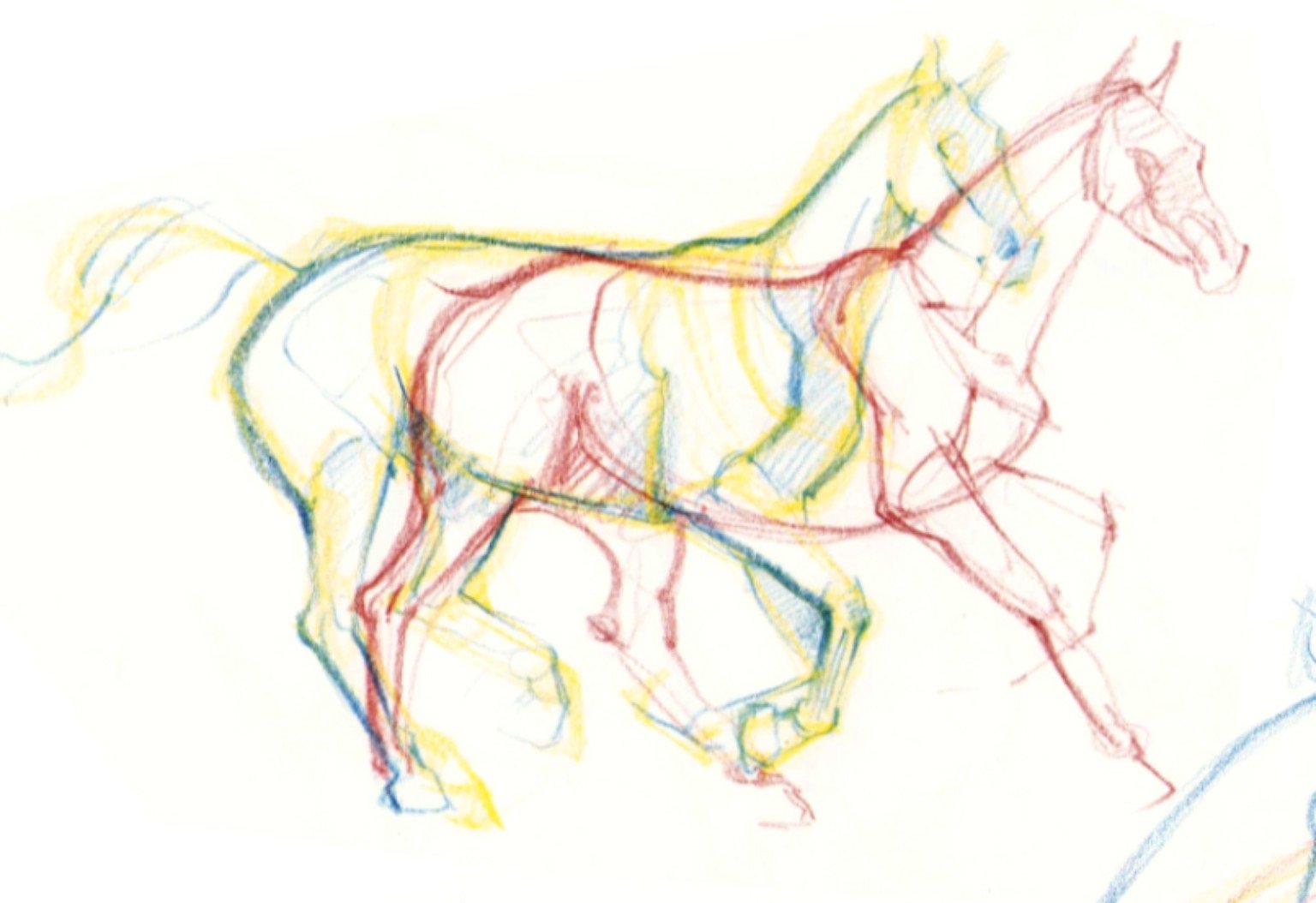
This work began without a clear idea of the final result. My starting point was observing how a horse pushes off the ground with its right hind leg. I played a video repeatedly and drew directly from the moving image.
In the first sketch, I used yellow pencil to capture the main lines quickly, blue to clarify the form, and red to continue recording the movement. Because the horse was moving, the lines did not coincide. The unexpected overlap interested me and suggested the possibility of making a larger work.
15 August — Scale and the First Major Decision
I first chose a format of 30 × 40 cm. Almost immediately, I realised it was too small. Several overlapping phases would have formed a dense tangle of lines, leaving too little space for the movement to read clearly.
I abandoned that format and took a full sheet of Saunders Waterford paper, 55 × 75 cm.
Changing the scale also changed the task. There was more space between the lines, and the blue phase could begin to separate from the yellow and become a movement phase of its own.
I started drawing directly with coloured pencils. They helped me tell the overlapping lines apart without getting confused. But coloured pencil has a drawback: it is difficult to erase, and trying to remove it often leaves dirty marks on the paper.
So I decided to try not erasing anything at all. I wanted to see what would happen if I left every line, including the mistakes, and kept working over them.
I noticed that these lines recorded the history of my corrections and decisions. What began as a practical choice dictated by the material gradually became an important part of the work. When certain lines became too distracting, I softened them with white acrylic rather than removing them completely.
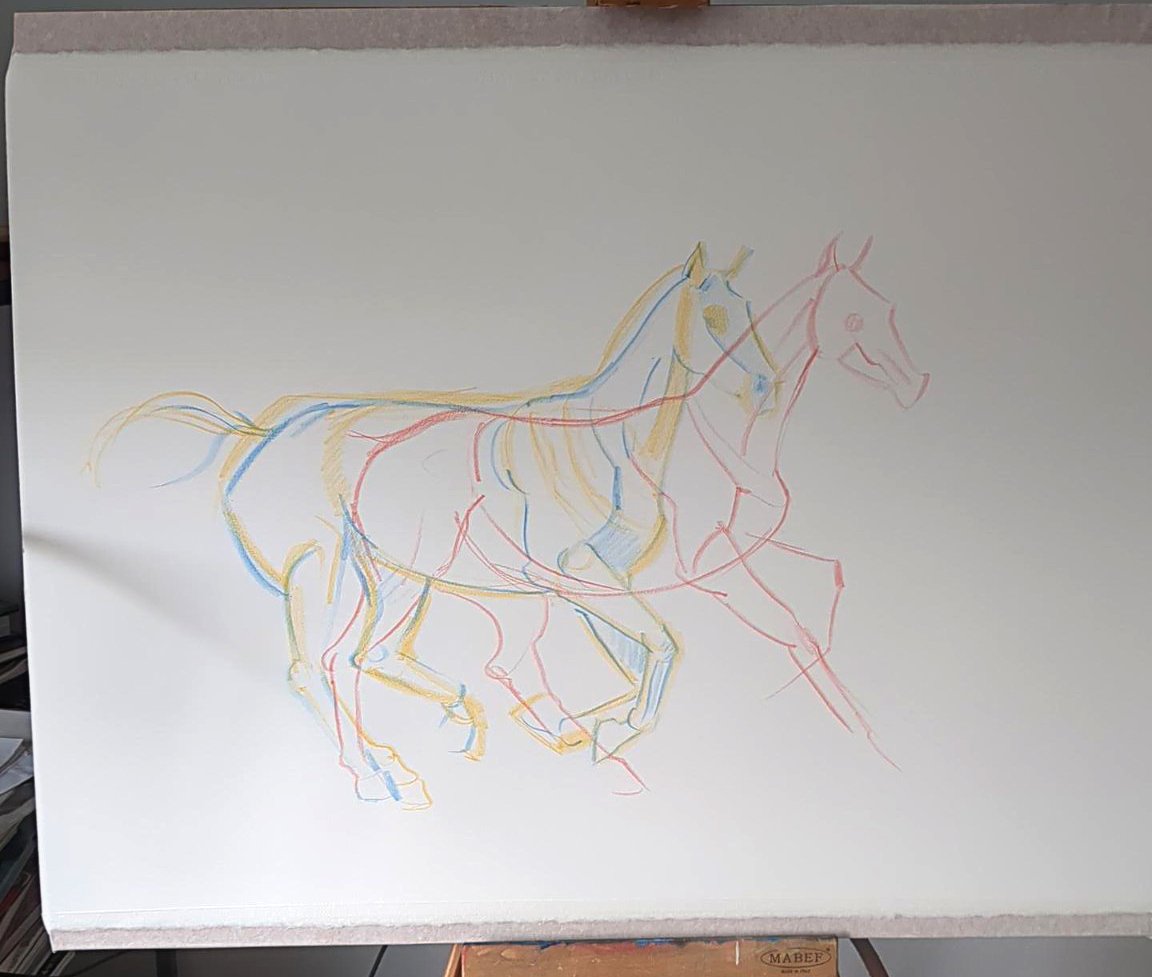
First stage of the composition on the full 55 × 75 cm sheet.
Reflection: Scale became part of the work itself. Enlarging the format did more than reproduce the sketch: it allowed the overlapping phases to develop.
16 August — The Yellow Phase
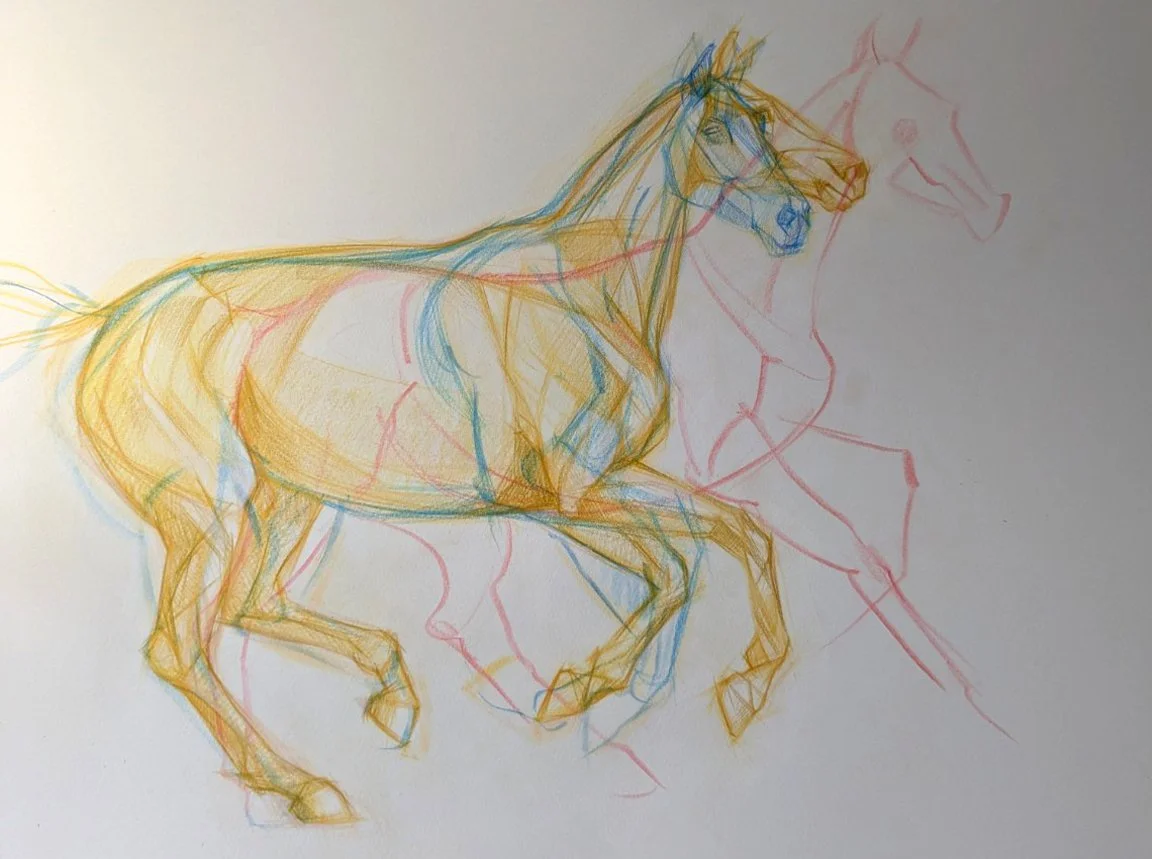
The yellow figure was the first to take shape. I worked on the main mass of the body, the neck, head and legs, while trying not to turn the quick, open sketch into a fully enclosed anatomical drawing.
The main difficulty was finding a balance between a convincing structure and the lightness of the lines.
Gradually, yellow became the underlying phase from which the others could emerge.
The exploratory lines remained visible. A mistake no longer automatically meant erasing an earlier version. It became a record of a previous stage of the decision.
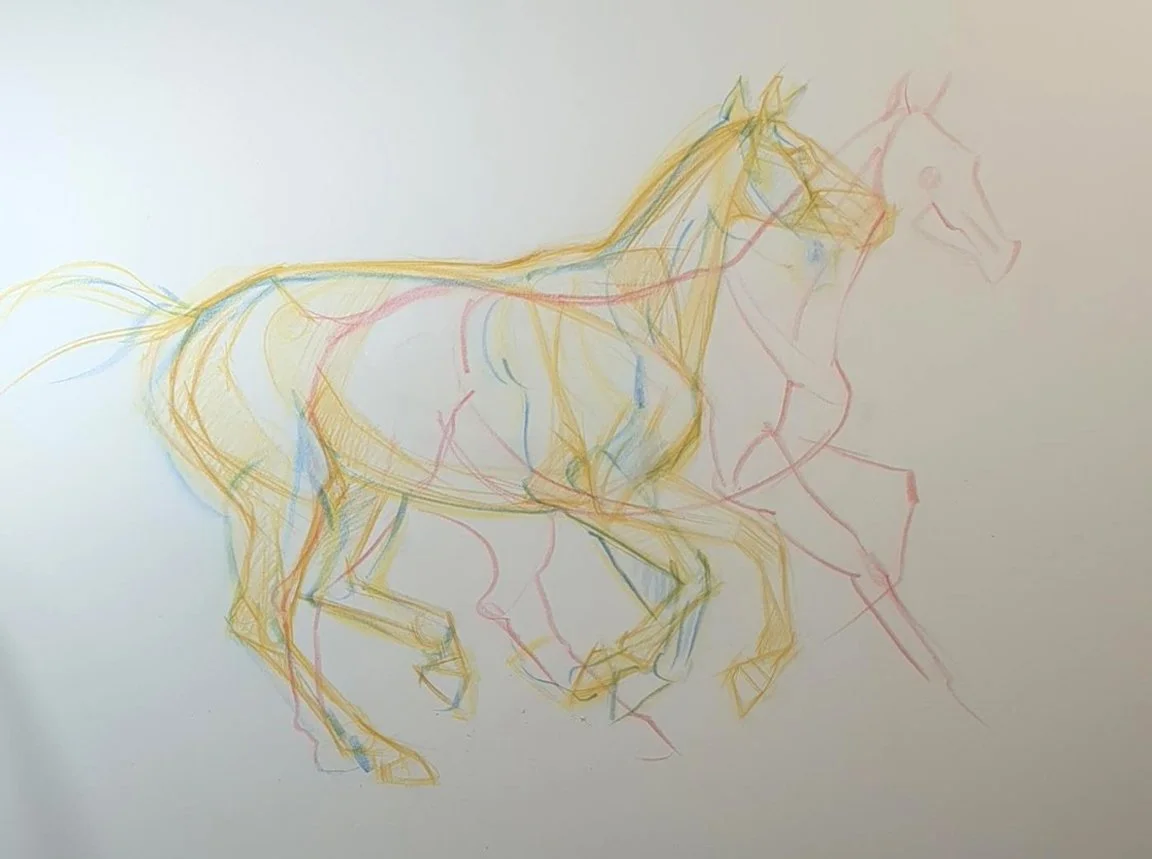
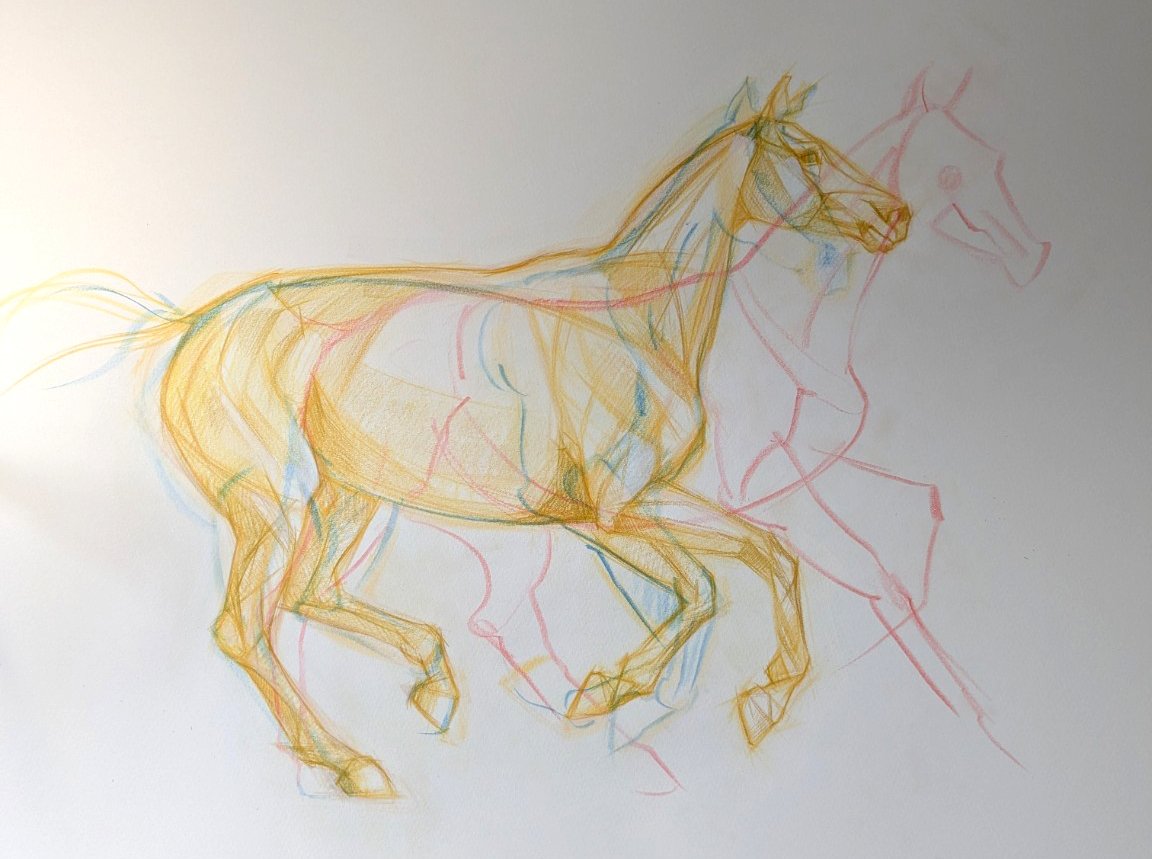
The yellow phase gradually establishes the main mass of the horse.
17 August — Blue Becomes Independent
At this stage, my original approach changed in an important way.
In the small sketch, blue had mainly been a way to correct or clarify the yellow drawing. On the larger sheet, it gradually became a separate phase of movement.
I began working through the head, neck, chest and front legs of the blue figure, while trying not to separate it completely from the yellow.
What mattered most was the feeling that one form was emerging from another, rather than simply sitting on top of it.
A shared sense of support also developed in the lower part of the drawing. Some leg positions from different phases met at the same point, linking several moments of movement within one structure.
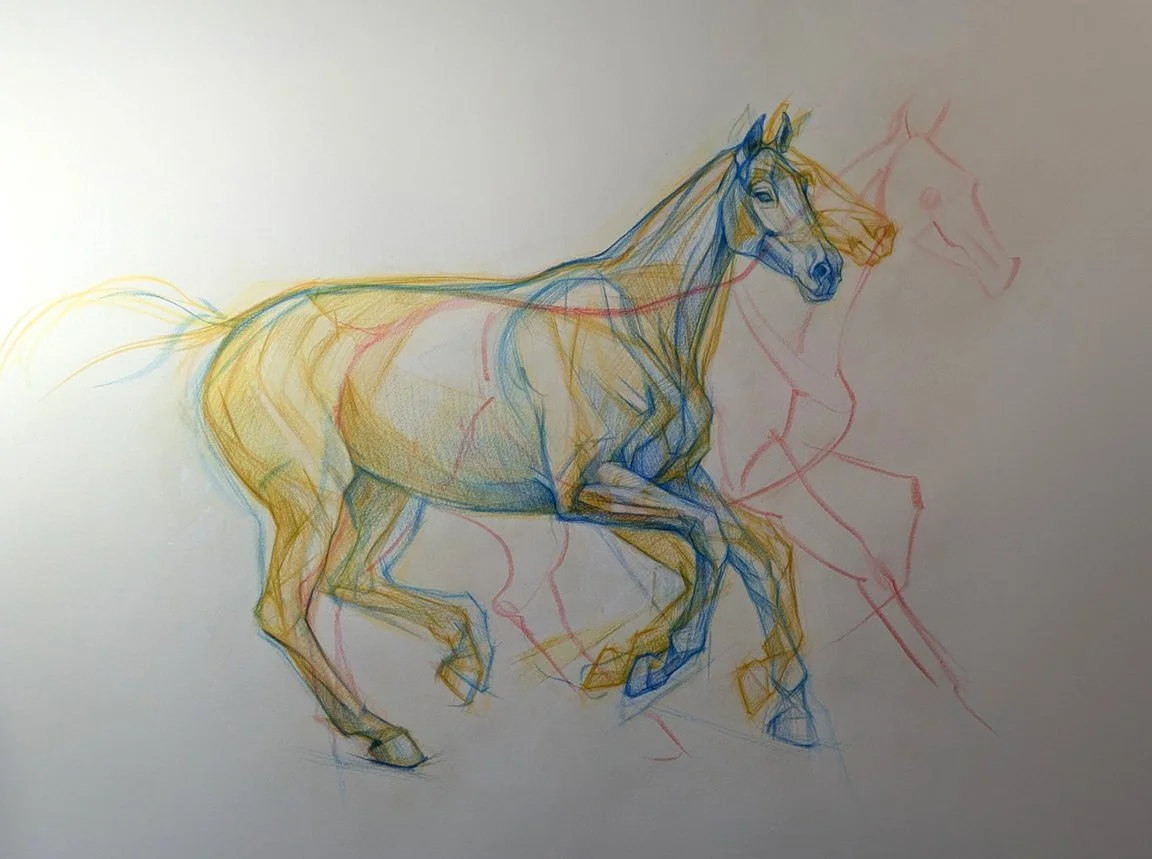
By the end of the day, a new problem had appeared: the blue phase was the clearest anatomically and was beginning to dominate the others.
I deliberately stopped developing it.
I realised that the goal was not to finish three separate horses. If each figure had a complete outline and the same level of detail, the movement would break up into three independent images.
It was more important to keep the forms connected and overlapping.
Reflection: Completing an individual form can weaken the work as a whole. Sometimes it is necessary to stop earlier.
20 August — The Red Phase: Expanding the Movement
Before developing the red phase in detail, I decided to adjust its original position slightly.
I moved the red head about one centimetre forward. This small shift solved several problems at once: it created more space between the heads, opened the space between the red elbow and the blue chest, and made the overall gesture broader.
I decided not to move the entire figure forward mechanically. The pelvis and withers could remain almost within the earlier phases. The forward movement would come mainly from changes to the shoulder, chest, neck, head and front legs.
The red phase was becoming more than a third figure: it was the next impulse of movement.
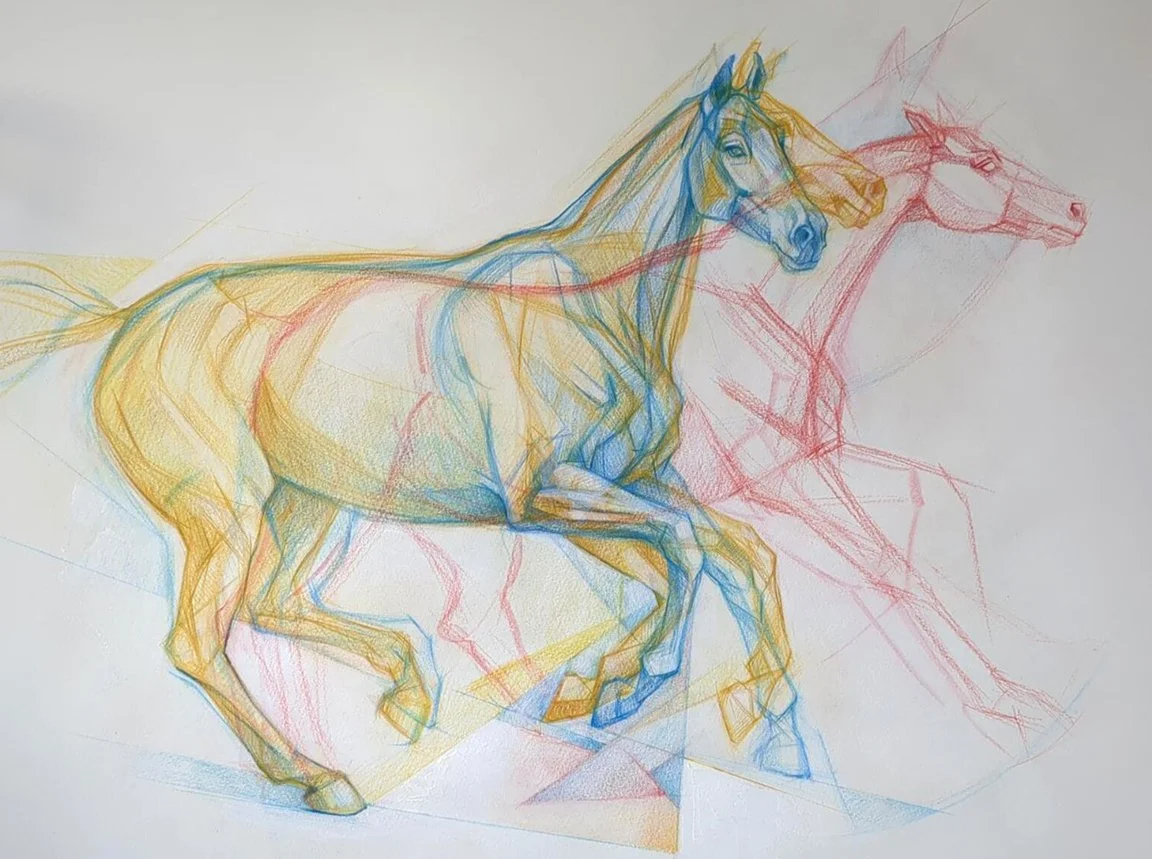
I gave the extended front leg a strong forward reach. The most difficult area was the point where the neck, chest and raised front leg meet. Anatomically, this part of the body is compressed, but if the gap became too narrow, the space between the forms would disappear.
Instead of moving the whole form, I corrected lines within it. This kept the tension in the raised leg while opening up the space slightly.
I made the lower line of the extended leg stronger, while leaving the bent leg lighter.
When the Search Began to Take Shape
At the same time, another element appeared unexpectedly.
In places where exploratory lines had built up, I wanted to make them more geometric. I began turning certain intersections and earlier lines into translucent planes and angles.
This decision was intuitive, but it fitted the direction the work was taking.
The geometry was not added as decoration. It grew out of the existing lines, as though the areas where I had been searching for the form were beginning to take on a clearer structure.
I set myself three limits:
— The geometric shapes had to grow from existing groups of lines.
— They had to remain secondary to the figure.
— Each shape had to support movement, balance or tension, rather than merely fill an empty space.
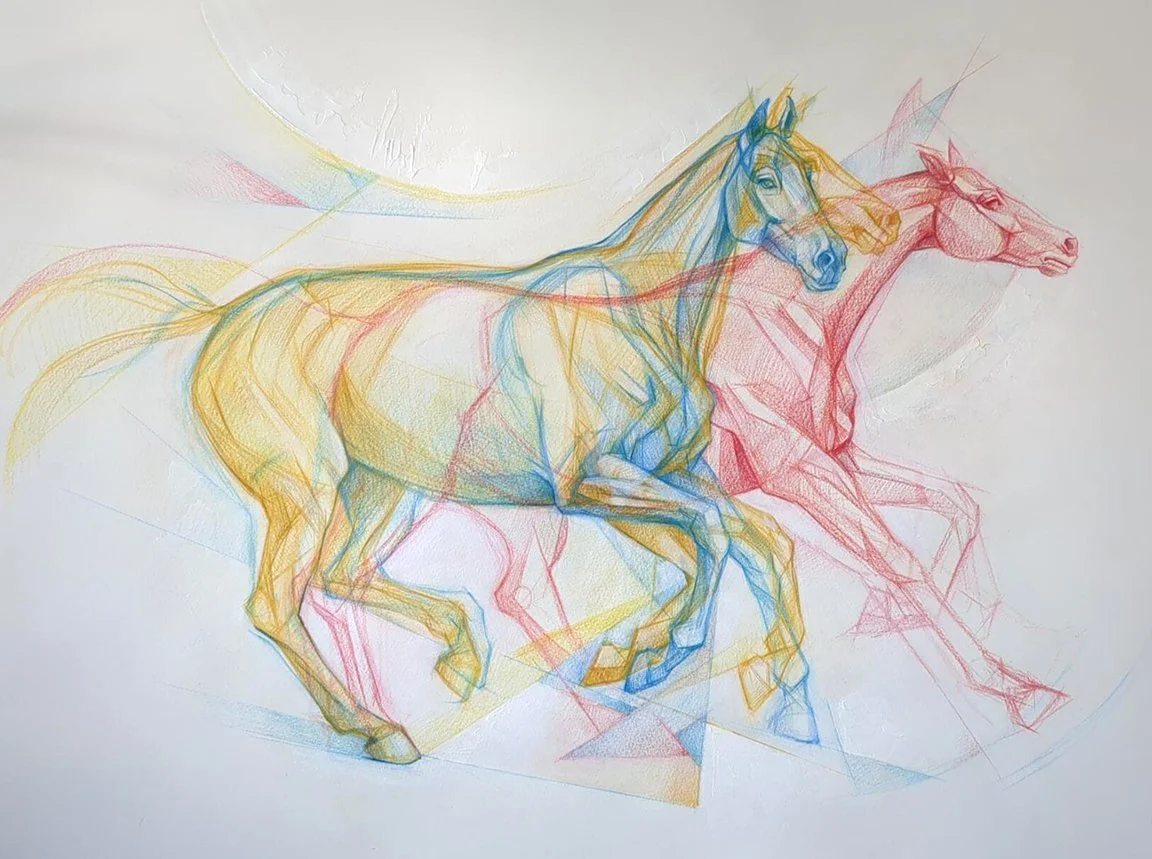
By the end of this stage, the horse’s organic form, the traces of earlier decisions and the geometric shapes had begun to work together.
21 August — Knowing When to Stop
When I looked at the work the following day, I realised that I did not want to add anything else.
The red phase now moved far enough forward. Its front section was clear enough, while the rear could remain more fragmented.
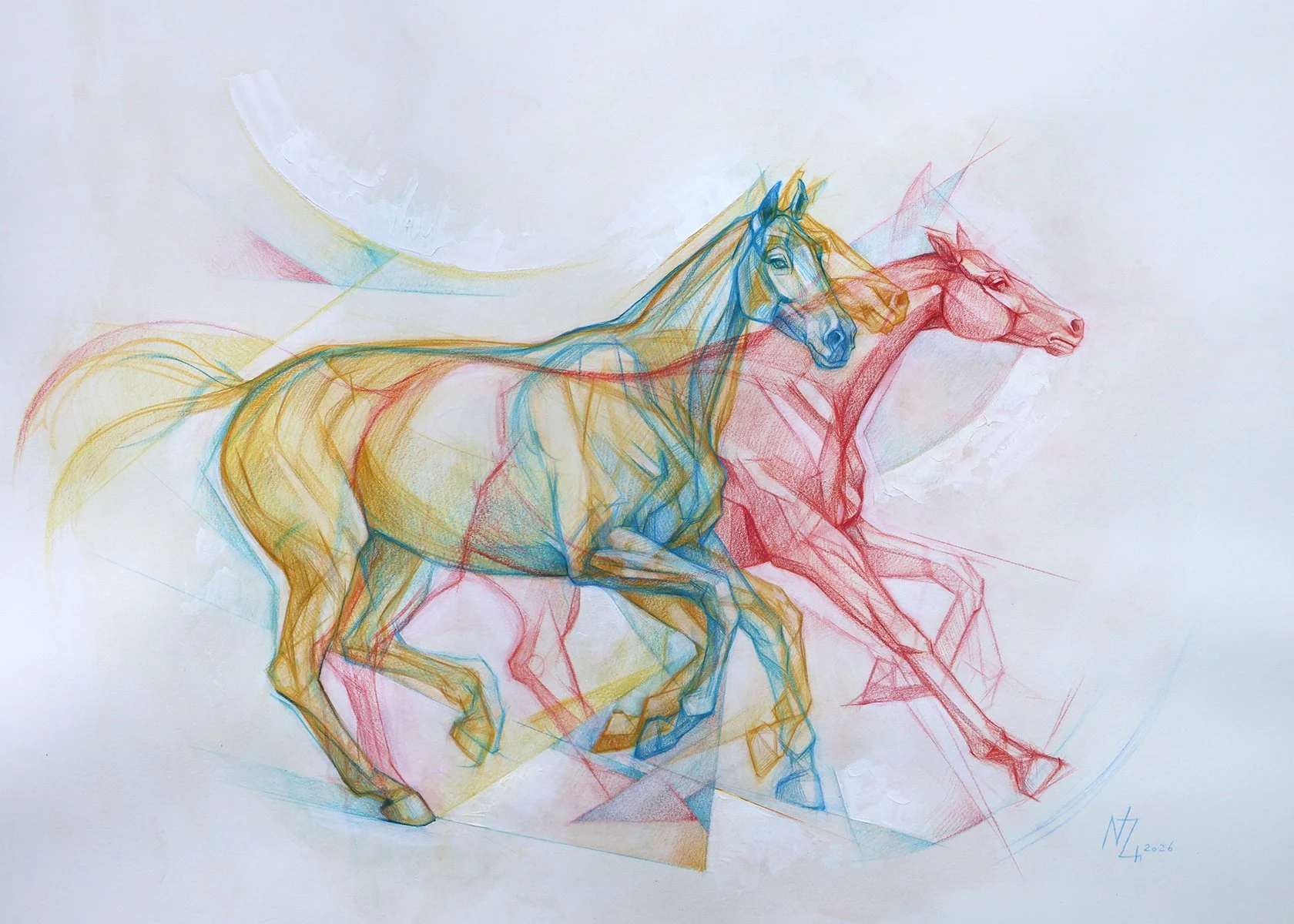
The three phases were deliberately left at different levels of definition:
— Yellow is softer and less defined, still connected to the initial search.
— Blue is the most clearly constructed and anatomically developed.
— Red is more directional, open and incomplete in places.
None of them exists completely apart from the others.
The exploratory lines remained. Some were only softened with white acrylic. The geometric fragments stayed where they had emerged from the process.
I stopped not because there was nothing more I could draw.
I stopped because the work had already said everything I wanted it to say.
What I Was Investigating
I began by studying how a horse pushes off the ground with its right hind leg. As the work developed, another layer of time appeared: the movement of my own artistic search.
One phase of the horse’s movement overlaps another, just as one drawing decision overlaps the trace of an earlier decision.
An incorrect or rejected line does not disappear. It remains as evidence that, at a certain moment, the work might have developed differently.
The surface therefore records several things at once:
— physical movement;
— observation;
— a decision made;
— a decision revised or rejected;
— the passing of time during the making of the work.
In the end, I became interested not only in how to draw movement, but also in how a work of art can preserve the movement of the thoughts through which it was made.
What I Learned
1. Let Go of the Need to Finish Everything
Not every work has to be perfectly finished.
A fully closed form is not always stronger than an open one. Fragments and unfinished areas give viewers room to see and complete things for themselves.
I want to learn to leave my work open, rather than always trying to finish and explain everything.
2. Accept Imperfection
In this work, I deliberately challenged my fear of imperfection.
The decision not to erase anything became more than a technical method. It was also a personal exercise: allowing earlier attempts to exist alongside the final decisions.
Not hiding the path to the result.
3. Allow Risk
Not every decision can be tested or guaranteed in advance.
Some parts of this work were developed through careful analysis, while others came from intuition. The geometric shapes, the changing visibility of the phases and the different strengths of the figures all emerged as I worked.
I want to learn not only to control a process, but also to let it lead me somewhere unexpected, even at the risk of failure.
4. Leave Room for the Viewer
Not every anatomical detail needs to be drawn.
Sometimes a few key lines are enough for viewers to complete a body, a leg or the direction of movement in their minds.
This leaves room between the image and the way it is seen.
Conclusion
This work began with a study of how a horse pushes off the ground with its hind leg. The unexpected overlap of coloured lines in the first sketch suggested the possibility of making a larger work.
But as I worked, the subject expanded.
The movement of the horse through time became connected with the movement of my own thinking through time.
A trace was no longer only a sign of the animal’s movement. It also became a record of searching, doubts, decisions and changes.
For me, the work was also about moving away from the constant need for a flawless, finished image: leaving parts of the form open and preserving imperfection, risk and the history of how the work came about.
Lines that I would normally have erased before calling a work finished became part of the finished work itself.
The drawing preserves more than an image of movement. It also preserves the history of its making.